TL;DR: The Outer Worlds 2 is the RPG Obsidian fans have been waiting for since New Vegas. Bigger, smarter, funnier, and way more reactive than the first game. The first act drags badly, some side quests are pure busywork, and the soundtrack is basically invisible. But once it clicks — and it does click — it really clicks. On Game Pass it’s an immediate yes. At $70 it’s still worth it if RPGs are your thing.
Rating: 8.3/10
Every time Obsidian releases something, everyone has the same question in mind.
“Is this their New Vegas moment?”
The first The Outer Worlds came out in 2019 and the answer was no.
It was a good game. Short. Small. A proof of concept more than a full statement.
People loved the writing and the tone but left feeling like Obsidian had only shown you the sketch, not the painting.
Avowed came out earlier in 2025. But still its a no. Its a different kind of game that comes with different problems.
The The Outer Worlds 2 dropped October 29, 2025 and the answer is finally, genuinely, yes its a real New Vegas successor.
Or at least — it’s the closest they’ve gotten in fifteen years.
That’s not a small thing. That’s a big deal.
What’s Going On In The Outer Worlds 2
You’re an Earth Directorate Commander. Think interstellar federal agent — your job is to investigate corrupt governments and corporations across the universe.
You get dropped into Arcadia, a colony system being ripped apart by three factions at once, a mysterious corporate invasion, and spatial rifts that are literally tearing the colony off from communication with Earth.
Your very first mission goes wrong. You wake up with crew missing, a broken ship, and a list of problems that only gets longer from there.
The alternate history setup is clever. President McKinley wasn’t assassinated in 1901 in this timeline. Theodore Roosevelt never took power, never broke up the big business trusts, and corporations just kept growing unchecked for 150 more years. By the time you show up in Arcadia, everything is owned, branded, and monetized. Everyone is either a customer, an asset, or both.
The satire hits you over the head with a brick. That is completely intentional.
The Three Factions — And Why They Actually Matter
This is where the game separates itself from the first Outer Worlds, and from most RPGs pretending to have meaningful politics.
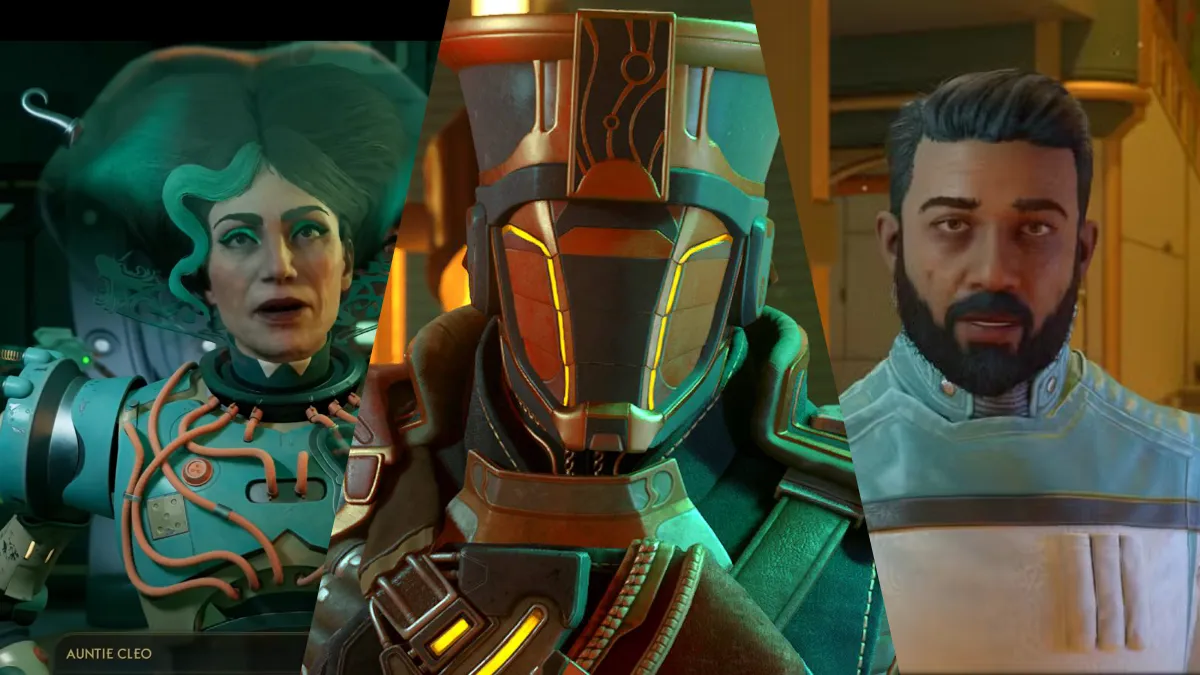
The Protectorate runs Arcadia. Authoritarian dictatorship, hereditary rule, founded by the inventor of the Skip Drive — the faster-than-light engine that made interstellar colonization possible. Citizens get assigned roles at birth. Dissent gets “treated” through a process called Mental Refreshment, which is exactly as horrifying as it sounds. The current Sovereign, Henry Varick, is supposed to be in charge — except his own Consul had him lobotomized to keep him as a useful figurehead while Thoreau runs everything. The Protectorate is your primary antagonist, but individual members inside it are complicated. Some of them are decent people caught in a machine they can’t escape.
Auntie’s Choice is the corporate invasion. Built from a merger between Auntie Cleo’s and Spacer’s Choice — both from the first game — it is the most cheerfully evil megacorp in recent memory. Their PR campaign is warm and friendly. Their internal memos are unspeakable. They want to control the rifts and monopolize Skip Drive technology to own every trade route in the galaxy. You’ll find vending machines inside active warzones. You’ll read employee newsletters congratulating workers on dying efficiently.
The Order of the Ascendant is the wildcard. Originally the Protectorate’s state religion, they broke off and went rogue. They’re obsessed with solving what they call “the Equation” — some mathematical answer to the rifts that they believe will advance humanity. Part science cult, part bureaucracy, completely disconnected from normal human concerns. Not evil. Just so focused on their goal that collateral damage barely registers.
None of these three factions are purely good or purely evil. That’s the point. The Protectorate has members who genuinely believe in order and stability. Auntie’s Choice has employees who are just people trying to survive inside a system bigger than them. The Order has noble goals executed through methods that hurt real people.
The choices you make between these factions have real consequences. Side with Auntie’s Choice against the Order and a negotiation you might have brokered falls apart. Broker peace instead and the final boss fight changes — Auntie Cleo herself shows up to fight alongside you. Betray the wrong people and companions leave. Help the wrong faction and a city gets hit with a relay crash because of a choice you made two planets ago.
This is what the first Outer Worlds never quite got to. The factions there felt like set dressing. Here they’re the whole game.
The Choices Actually Matter — And That’s Not Marketing Speak
Let’s be specific about how this works.
You build your character at the start. Skills, background, perks, starting traits. Then after the opening sequence, you lose the ability to respec. That’s your character for the whole run.
This is the most important design decision in the game and it’s genuinely controversial. Some people hate it. I think it’s the right call — it makes you actually commit to who your character is, and the game rewards that commitment in ways that feel real.
High Speech and you’ll talk your way through situations that a combat build has to fight through. High Stealth and you can bypass entire boss fights. High Science and you’ll find quest solutions the person next to you never saw. Locked dialogue options exist throughout the game — choices grayed out with the skill requirement shown right next to them. It teaches you that no single playthrough sees everything.
Talk to someone who played it differently. Their story is actually different. Not slightly different. Structurally different in places.
The Flaws System Is One of the Best Ideas in RPGs in Years

The Flaws system is the thing nobody’s quite talking about enough.
Flaws are negative traits the game offers you based on your actual behavior. It watches what you do and reacts to your patterns.
Get knocked down by robots too many times? The game notices. It offers you Technophobia — you deal more damage to automatons but take more from them in return. Accept it, get a free perk point.
Spend too much time crouching? You get offered Bad Knees — faster crouch movement speed, but your knees crack loudly when you stand up, alerting every enemy within ten meters. Try being stealthy with that.
Speed through dialogue options too fast? The game notices and offers you a flaw that will randomly choose dialogue options for you in exchange for bonus XP. There’s even a flaw called Compulsive Liar that makes you lie to literally everyone you meet. And one that makes you automatically steal anything you walk past.
The genius is that these aren’t random. They’re the game holding up a mirror to how you specifically have been playing and going “okay, you want to do that? Let’s make it part of your build.”
You can decline any flaw. But declining means no perk point. And perk points matter when the level cap is 30 and skills are permanent.
One guy accepted every single flaw offered to him. His character was an absolute disaster. He said it was the most fun he’d had in an RPG in years.
The Companions — Real Talk
Six companions. All optional. Two at a time in the field.
Niles — Earth Directorate engineer, first companion you meet. Acts as a walking workbench so you can craft and upgrade without finding a station. Good tank option. Reliable. His quest is solid but not spectacular.
Marisol — Order of the Ascendant assassin, older, seen everything, impressed by nothing. Her dialogue is dry and devastating and her companion quest is the best in the game — a proper spy story with real moral weight. She’s the reason people replay this game.
Tristan — Protectorate soldier with a giant hammer that doubles as a grenade launcher. Best tank in the game. Zero ranged capability outside that hammer. His quest arrives late but it’s worth doing.
Aza — cultist from the Glorious Dawn, close-range knife fighter, explosive companion ability, dies in two hits if you pull aggro off her. Her quest ends with her being offered the chance to disband the entire cult.
Inez — field medic from Auntie’s Choice, starts with no companion ability until you finish her first quest. Versatile support but takes a while to come online.
Valerie — robot from the Earth Directorate. Multiple healing and buff options, great support, low damage, low survivability. Genuinely useful if you build around her.
Each companion is tied to a faction. Take two from opposite factions on a long run and they’ll eventually clash. Let the tension build long enough and they’ll try to leave. Let it build further and they’ll try to kill you.
The honest take though. Most of them stop surprising you somewhere in the middle of the game. Marisol is the exception. A few of the others feel like they run dry around hour 25. Companion quests arriving too late in the runtime is a real pacing problem Obsidian hasn’t fully solved yet.
The First Act Is a Real Problem
Eden, your opening planet, is beautiful and too big for its own good.
You land, get handed a pile of errands disguised as quests, and spend the first several hours clearing enemy camps and fetching things while the game slowly introduces its faction politics. By the time you’re ready to leave Eden, you might already be tired.
Push through anyway.
The moment you’re past that first planet and the factions start bleeding into each other — when choices you made two hours ago show up in NPC dialogue, when a companion reacts to something you thought was throwaway, when a faction you barely interacted with sends someone to thank you or threaten you — the game becomes something else entirely.
It front-loads its weakest material and buries its best stuff in the middle and late chapters. That’s not ideal. But what’s buried there is worth the friction of getting to it.
Combat — Better Than the First Game, Still Not the Star
The first Outer Worlds had fine combat. Serviceable. Nothing to write home about.
The sequel is meaningfully better. More weapon variety, cleaner gunplay, a double jump and slide that make movement feel less stiff, melee that actually has some weight behind it. The science weapons are back — absurd creative guns that do things regular guns don’t.
Different weapon types affect different enemies differently. Plasma melts humans but barely scratches machines. Shock weapons for robots. It’s not deep but it adds a layer of thought that the first game didn’t have.
Tactical Time Dilation (TTD) — Obsidian’s version of bullet time — returns. Slow down time, aim at weak points, deal massive damage. Using it well is the difference between a hard fight and an easy one.
Enemy AI is smarter than it was. On harder difficulties they flank you, target your companions first, and punish you for standing still. You’ll die more than you expect in this game.
The honest limitations: ammo runs dry constantly and crafting more at a workbench breaks the flow of exploration in an annoying way. The gunplay feels good but never feels great. Melee is improved but still feels secondary.
Combat is the support act. The real show is the talking and the choosing. Know that going in.
The World and the Satire
Arcadia isn’t one place. It’s a whole system — multiple planets and moons, each with their own environments, their own factions in conflict, their own flavor of the central satire.
Eden is tropical and green and corporate-cheerful on the surface. The frozen moon of Cloister is the Order of the Ascendant’s home — all monastery architecture and austere academic energy. Other locations range from industrial hellscapes to quietly devastating colonial ruins.
Each faction runs its own radio station that you can tune into from the pause menu. They play music, advertisements, and in-world commentary that reacts dynamically to your choices. Help the Protectorate fix a disaster and their station broadcasts you as a hero. Sabotage Auntie’s Choice and their station starts running hit pieces.
The best worldbuilding isn’t in cutscenes — it’s in corporate memos, propaganda posters, and dead people’s last logs that you find by poking around empty rooms. Obsidian earns it the old-fashioned way.
What Doesn’t Work
The first act already happened. But the other problems deserve naming.
Some side quests are pure filler. Obsidian’s best work makes even minor quests reveal something real about the world. A meaningful chunk of the side content here is just fetch and return. The gap between the best quests and the worst ones is huge.
The level cap at 30 hits before you’re done. It’s possible to max out while you still have companion quests and faction content left. There’s a flatness to late-game progression when nothing’s growing anymore.
Bugs. Not catastrophic at launch but consistent enough to notice. Dialogue that didn’t trigger. AI standing still in a fight waiting to be killed. An elevator that told me I was unauthorized and then let me in anyway. By the back half of the game you start expecting something to go slightly wrong in every quest.
The soundtrack is invisible. Forgettable background ambient that does nothing to build atmosphere or punctuate moments. For a game this ambitious and this witty the music is a genuinely strange miss. You’ll barely notice it exists, which is the problem.
Game Pass vs $70 — Let’s Be Honest
This shipped at $70 and missed Microsoft’s sales expectations. That’s public information now.
Part of that was the price point. Part of it was the slow start bleeding players before word of mouth could build. Part of it was the reality that good RPGs take a month for the actual discourse to catch up to them.
On Game Pass — play it tonight. No question.
At $70 — if you love RPGs, if choice-driven faction-heavy games are your thing, it’s worth full price. You’re getting 40-60 hours of content that genuinely plays differently on a second run.
If you’re casual, or you mostly play action games, or you bounced off the first Outer Worlds — Game Pass first. The slow opening will feel different when there’s no money at stake.
You can buy it for $69.99 on the Microsoft Store/Xbox Game Pass, PlayStation Store, or Steam.
The Final Scores
| Category | Score |
|---|---|
| Story | 8/10 |
| Combat | 7.5/10 |
| World & Factions | 9/10 |
| Characters | 7.5/10 |
| RPG Systems | 9.5/10 |
| Performance | 7/10 |
| Overall | 8.3/10 |
Story gets an 8. The premise is strong, the faction writing is genuinely excellent, the satire lands more than it misses. The ending wraps up a bit too neatly for a game that spent 50 hours building moral complexity. The first act drags the score down from where it could have been.
Combat is a 7.5. Better than the first game, still the weakest pillar. Ammo scarcity is genuinely annoying. Gunplay feels good but has a ceiling. TTD saves it from being a 6.
World and Factions is a 9. Three factions with real depth, real ideological conflict, and real consequences. The radio stations reacting to your choices are a small thing that says a lot about the level of care here. Docking a point for the bloated opening planet.
Characters sit at 7.5. Marisol is excellent. Tristan and Aza have their moments. The others are functional at best. Companion quests arriving too late is a recurring problem.
RPG Systems is a 9.5. The Flaws system is one of the best ideas in RPGs in years. Permanent build choices that shape your whole run, dialogue locked behind skills, faction reputation with real downstream consequences. This is what the genre should be doing.
Performance is a 7. Technically impressive in Unreal Engine 5. Also buggy enough to notice consistently throughout. Obsidian shipped rough and will patch — DLC is confirmed for 2026, hopefully the fixes come alongside it.
FAQs
Do I need to play The Outer Worlds 1 first?
No. The Outer Worlds 2 is set in a completely different star system with a new cast. The tone and universe carry over but the story is fully standalone. You won’t miss anything important.
Is it on Game Pass?
Yes. Day one on both Xbox Game Pass and PC Game Pass from October 29, 2025.
How long is it?
Main story alone is roughly 16-20 hours. With side quests, companion quests, and faction content you’re looking at 40-60 hours. A second playthrough with a different build pushes well past that.
Is it better than the first Outer Worlds?
Yes. Significantly. Better writing, bigger world, more reactive choices, improved combat, deeper systems. The first game was a decent foundation. This is the actual building.
Is it the new New Vegas?
Getting close. Obsidian themselves called it New Vegas in space during development and it shows in the faction depth, the build permanence, the way choices ripple. It doesn’t quite hit the same companion memorability or the specific poetry of New Vegas — but it’s the closest Obsidian has come since 2010.
Can you play as evil?
Pretty much yes. You can side with corporate authoritarians, betray every faction, let companions walk away, or in the worst ending — sacrifice the entire Arcadia colony to seal the rifts. No cartoon villain arc but genuine moral darkness is available throughout.
Is there DLC?
Yes. Two story expansions confirmed for 2026, included in the Premium Edition or purchasable separately.
Can I respec my character?
Once — right after the opening sequence. After that your build is permanent. Plan before you commit.
Is it worth $70?
If RPGs are your genre — yes. If you’re on the fence — Game Pass first, then decide.