TL;DR: Little Nightmares III is a decent game dressed in a great series’ clothes. The atmosphere still works in bursts. The Carnevale chapter is genuinely excellent. But at five hours for $39.99, co-op that’s online-only, and mechanics that barely scratch their own surface — it’s hard not to feel like something is missing. Because something is.
Rating: 6.5/10
Here’s the thing about Little Nightmares III that nobody wants to say directly but everyone is thinking.
Tarsier Studios — the team that made both previous games — left after Little Nightmares 2. They’re currently making Reanimal, which from every trailer looks exactly like what Little Nightmares III should have been. Darker. Weirder. More willing to go somewhere uncomfortable.
Supermassive Games stepped in. They’re not a bad studio — Until Dawn is genuinely great and they clearly understand horror. But they inherited a series with a very specific soul, and watching them try to replicate it for five hours is a slightly uncomfortable experience.
Not because Little Nightmares III is bad.
Because it’s fine. And fine is the worst thing a Little Nightmares game can be.
Low and Alone Are Fine Characters
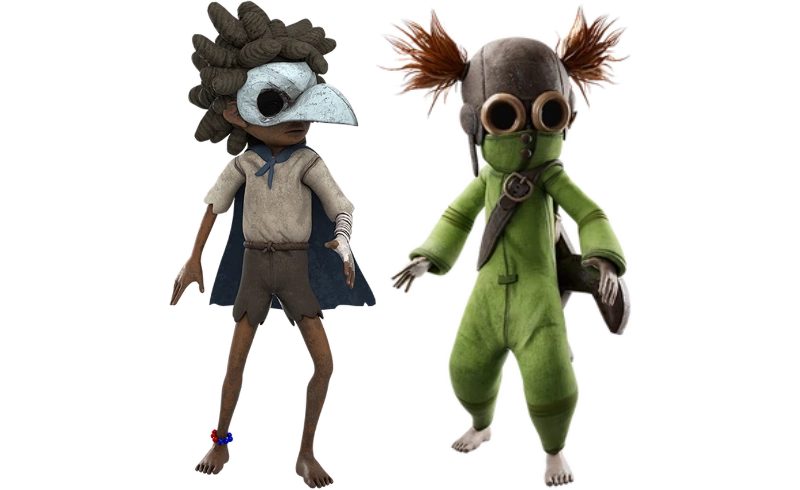
The two protagonists — Low in his white raven mask with a bow and arrow, Alone in her green jumpsuit with a wrench — look great on paper and in trailers.
Actually playing with them is more complicated.
Low’s bow cuts ropes and hits distant switches. Alone’s wrench breaks through weak walls and bashes low-lying buttons. These tools define basically every puzzle in the game. See a rope? Low shoots it. See a crumbling wall? Alone hits it. The game telegraphs its solutions so clearly and so immediately that there’s almost no puzzle-solving happening — just identifying which of two buttons to press.
The designs are genuinely good. The characters have charm in their animations. But they barely interact and you learn almost nothing about either of them by the time credits roll. In a series that made you feel genuine dread for Six and Mono without a single line of dialogue — that’s a real step back.
The Co-op Is The Biggest Disappointment
Co-op is the headline feature of Little Nightmares III. It’s the thing every trailer led with.
It’s online-only.
No couch co-op. You and a friend need separate devices and a stable connection. Supermassive said this was to preserve “atmosphere and immersion.” Which is a strange justification for a series people have been playing in the same room together since 2017.
There’s a Friend’s Pass so your co-op partner doesn’t need to buy the full game, which helps. But the experience feels like it was designed for two people sitting next to each other, pointing at the screen, communicating in real time — and then that mode was removed for reasons that don’t fully make sense.
Playing with the AI companion instead is fine. It does its job. It won’t ruin the experience. But “fine” keeps coming up with this game.
The Spiral Has Its Moments
The setting — a cluster of disturbing locations called the Spiral, floating somewhere in the Nowhere — is the best thing Little Nightmares III does.
Each chapter occupies a different nightmare space. Creepy doll-filled nurseries. A spider-infested area that genuinely unsettled me. And then there’s The Carnevale.
The Carnevale is what the whole game should have been.
A twisted carnival with towering grotesque performers, flickering lights, horrifying chase sequences, and a visual design that felt closer to the original series’ energy than anything else in the game. When Little Nightmares III works — when it stops explaining itself and just lets the atmosphere exist — it’s genuinely effective.
The problem is how rarely it commits to that.
The first half of the game is slow. Puzzles are safe. The horror feels considered and careful in a way that bleeds tension before it can build. Things improve significantly in the back half — the game finds its rhythm eventually — but getting there requires patience the series previously never asked for.
Five Hours. $39.99.
This is the conversation nobody wants to have but everyone is having.
Little Nightmares 1 was $15 for roughly three hours. Little Nightmares 2 was $30 for around five. Little Nightmares III is $39.99 for five hours.
The price hike would make sense if the experience had grown meaningfully. It hasn’t. The game is roughly the same length as its predecessor at a significantly higher price, with mechanics that don’t go as deep as the two-tool system promises and a co-op implementation that frustrates more than it delivers.
The atmosphere is still distinctive. Christopher Larkin didn’t return — Hugo Long composed this one — and while the new score is competent, it doesn’t hit the same emotional register as the first two games.
Five hours at full price isn’t automatically bad. But it needs to be five extraordinary hours. These aren’t quite that.
What Supermassive Got Right
To be fair — and this review is trying to be fair — Supermassive clearly understand what the series looks like.
The visual presentation is impeccable. The scale of the monsters. The way small children move through spaces designed to make them feel tiny and exposed. The hand-drawn quality of the lighting and shadow work. All of that is intact and it still works.
Some of the enemy designs are excellent. A particular chapter’s main antagonist is deeply unsettling in a way that felt like classic Little Nightmares — slow, purposeful, inescapable. The chase sequences when they actually kick in are tense.
And The Carnevale, again. It’s a legitimately great chapter in a series known for great chapters. If the whole game operated at that level, this would be a very different review.
The Honest Version
Little Nightmares III is not a bad game.
It looks right. It sounds mostly right. It has chapters that genuinely deliver the series’ signature dread. Fans of the first two will find things to love here — particularly in the back half.
But it’s also a game that cost more, delivers less mechanically, made co-op online-only in a game that screams for couch play, and shows its seams whenever it reaches for the depths that Tarsier used to find instinctively.
The soul of the series is somewhere in there. Supermassive found it in bursts. They just couldn’t hold onto it consistently.
Meanwhile, Reanimal exists. The people who actually built Little Nightmares are making their next game without the IP constraints. Whether that’s better or worse than this — we’ll see. But it’s impossible to review Little Nightmares III without knowing that information.
If you love this series — play it. It’s worth seeing. Just wait for a sale.
6.5/10
FAQ
Is Little Nightmares III worth buying? At full price ($39.99 for about five hours), it’s a tough sell. The atmosphere works in bursts, The Carnevale chapter is excellent, and fans of the series will find things to enjoy. But the co-op implementation disappoints, the mechanics are shallow, and the pacing is uneven. Wait for a sale unless you’re a committed series fan.
Do you need to play Little Nightmares 1 and 2 first? Not strictly — Little Nightmares III follows new characters in a new setting. But the series’ lore threads connect in ways that hit harder if you’ve played the originals. Starting from the beginning is recommended.
Is Little Nightmares III co-op only? No — you can play solo with an AI companion controlling the second character. Co-op is online-only and does not support couch play.
Why did the developer change for Little Nightmares III? Tarsier Studios, who made the first two games, left the franchise after Little Nightmares 2. Supermassive Games (Until Dawn, The Dark Pictures Anthology) took over development. Tarsier is currently developing Reanimal, a separate horror game.
How long is Little Nightmares III? Around five hours for a standard playthrough. It’s the same approximate length as Little Nightmares 2 but priced at $39.99 compared to the previous game’s $30 launch price.
What platforms is Little Nightmares III on? PC, PS4, PS5, Xbox One, Xbox Series X/S, Nintendo Switch, and Nintendo Switch 2. Released October 10, 2025.